Now in the hills

DarjeelingTour Plan
Photo: Indrajit Das · CC BY-SA 3.0, Wikimedia Commons

High-glacier indigo and rhododendron

North Sikkim

Yak country, high lakes and Lepcha valleys

Best Mar – May · Oct – NovPackages from ₹7,000
North Sikkim is the Mangan district above Gangtok: Lachung and Yumthang to the east, Lachen and Gurudongmar Lake (≈ 5,430 m) to the north, and the Lepcha reserve of Dzongu by the Teesta. Every trip needs a permit through a registered operator, and roads close often, so check current status before you travel.

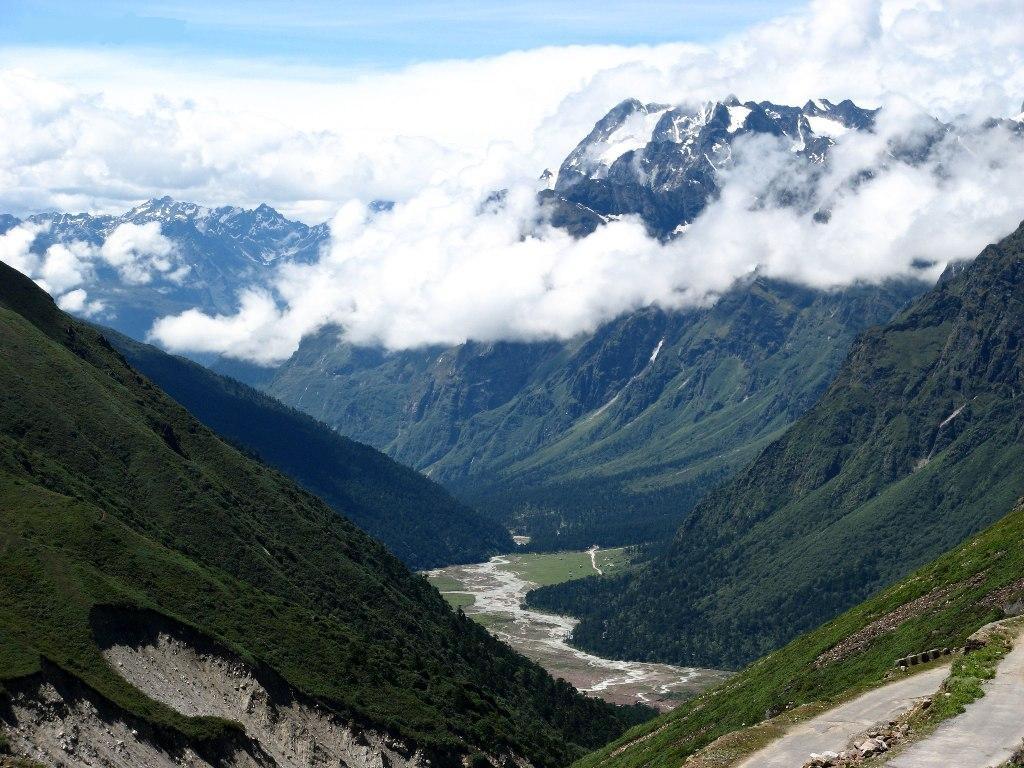
North Sikkim is the biggest and emptiest district of the state. Since 2021 it has been called Mangan district, after its small headquarters town on the Teesta. The 2011 census counted about 43,700 people in an area larger than the other districts, so most of what you see is forest, river gorge, moraine and snow. The road climbs from about 1,000 m at Mangan to 5,430 m at Gurudongmar Lake in a single day's drive, which is the first thing every traveller here needs to understand.

There are two valleys that most people come for. The Lachung valley runs east to Yumthang, the rhododendron meadows of the Shingba sanctuary and, on a good day, Zero Point at Yume Samdong. The Lachen valley runs north past Thangu to Gurudongmar Lake, close to the Tibetan plateau. Both villages are run by their own traditional councils, the Dzumsa, and both live on tourism, apples, potatoes, yak and sheep.

Lower down, the Teesta cuts through Lepcha country. Dzongu, across the river from Mangan, is a reserve where only Lepchas may own land. You need a separate permit and you stay in family homestays, not hotels. On the highway from Gangtok you also pass Kabi Lungchok, where Lepcha and Bhutia leaders swore blood brotherhood, and Phodong, one of the six main monasteries of Sikkim.

We will be straight with you about access. The October 2023 glacial lake outburst flood destroyed the Teesta-III dam at Chungthang and long stretches of road. Lachen stayed shut to tourists for most of the next three years, and landslides in 2024, 2025 and 2026 closed Lachung and Lachen again for months at a time. Plans here must be flexible, and every booking should come with a fallback. Check current status before you travel.

Told in the hills

The night South Lhonak broke

South Lhonak is a glacial lake at about 5,200 m in the far north-west of the district. In 1977 satellite images showed it at about 17 hectares. As the Lhonak glacier retreated, it grew, and by 28 September 2023 it covered about 167 hectares. Scientists had listed it among the most dangerous lakes in the Sikkim Himalaya, and in 2018 pipes carried up by yak were installed to start draining it. An early warning system was still being planned when the rains came.

In the first days of October 2023 Sikkim received several times its normal rainfall. On the night of 4 October the lake burst its moraine wall. A warning reached the Teesta-III dam at Chungthang around midnight, and the operators tried to open the gates, but the flood arrived first. The 1,200 MW dam was destroyed in minutes. Downstream the Teesta rose by 15 to 20 feet, through Dikchu, Singtam, Rangpo and into West Bengal and Bangladesh.

More than 90 people were confirmed dead within two weeks, among them Indian Army soldiers, and fifteen bridges were lost. For North Sikkim the flood rewrote the map: Chungthang was badly damaged, the road to Lachen was cut, and Lachen did not reopen to tourists until March 2026, after the new Taram Chu bridge was built. That is why we ask you to treat every North Sikkim plan as provisional.

Pinned to the board

Did you know

Gurudongmar Lake sits at 5,430 m according to the Government of Sikkim, which makes it one of the highest lakes in the world that tourists can drive to.

The Teesta is born up here: Tso Lhamo lake, about 5 km from Gurudongmar, is counted as its source, and the river joins its Lachen and Lachung arms at Chungthang.

The botanist Joseph Dalton Hooker walked up the Lachen valley in May 1849 and later went into the Lachung valley, collecting rhododendron seed that ended up in English gardens.

Lachen and Lachung govern themselves through the Dzumsa, a village council headed by an elected Pipon, which the Sikkim government formally recognised in 2001.

Dzongu was declared a reserve for the Lepcha people by a royal proclamation of the Chogyal in 1956, and outsiders still need a special permit to enter.

Why go

What North Sikkim does best

Yumthang in rhododendron season

From late April into May the Shingba Rhododendron Sanctuary around Yumthang (3,564 m) flowers in reds, pinks, whites and yellows. Go early in the morning from Lachung, 24 km away, before cloud fills the valley, and add Zero Point if your permit and the road allow it.

Gurudongmar at dawn

The drive from Lachen starts at about 4 am and climbs past Thangu to a lake at 5,430 m, sacred to Buddhists and linked by legend to Guru Padmasambhava. Twenty to thirty minutes at the shore is enough; the altitude is the real story of the day.

A Lepcha homestay in Dzongu

Across the Teesta from Mangan, Dzongu is a Lepcha reserve of cardamom groves, rice terraces and hot springs. You sleep in family homes, eat what the farm grows and walk to villages with a local guide. It needs its own permit.

Lachung and its Dzumsa

Lachung is a village of wooden houses, apple trees and prayer flags at about 2,700 m, run by its own council of elders and an elected Pipon. Walk up to the 1880 Lachung Monastery and ask your host how the Dzumsa works.

Snow without an expedition

From December to March, snow usually lies around Lachung and on the road to Yumthang. For many families from the plains this is the easiest place in India to touch deep snow, but expect closures after fresh falls.

The highway's history stops

Between Gangtok and Mangan stop at Kabi Lungchok, where the Lepcha-Bhutia blood brotherhood was sworn, at Phodong Monastery and at the Seven Sisters Waterfall. Each is a short halt that turns a long transfer day into a story.

Stations on the line

Where to go in North Sikkim

Chungthang
Chungthang1,790 m

Where two rivers become the Teesta, and the flood struck

River town · best Mar – May · Oct – Nov · Transit nights
Dzongu
Dzongu1,200 m

The Lepcha reserve across the Teesta from Mangan

Valley · best Oct – Apr · 2–3 nights
Gurudongmar Lake
Gurudongmar Lake5,430 m

A sacred lake at 5,430 m, reached at dawn from Lachen

Lake · best Apr – May · Oct – Nov · Day trip nights
Kabi Lungchok
Kabi Lungchok1,400 m

Where Lepcha and Bhutia leaders swore blood brotherhood

Village · best Oct – May · Stopover nights
Lachen
Lachen2,750 m

The night stop before Gurudongmar, reopened in 2026

Village · best Apr – May · Oct – Nov · 1–2 nights
Lachung
Lachung2,700 m

Base for Yumthang, run by its own village council

Village · best Mar – May · Oct – Nov · 1–2 nights
Mangan and Singhik
Mangan and Singhik1,000 m

District town of cardamom, with Kanchenjunga from Singhik

Hill town · best Oct – Apr · 1 nights
Phodong
Phodong1,400 m

One of Sikkim's six great monasteries, 38 km from Gangtok

Monastery town · best Oct – May · 0–1 nights
Shingba Rhododendron Sanctuary
Shingba Rhododendron Sanctuary3,300 m

Forty-odd rhododendron species on the road to Yumthang

Wildlife sanctuary · best Apr – May · Day trip nights
Thangu and Chopta Valley
Thangu and Chopta Valley3,900 m

The tea-and-permit halt on the road to Gurudongmar

Valley · best May · Oct – Nov · 0–1 nights
Yumthang Valley
Yumthang Valley3,564 m

Meadows, hot spring and rhododendrons above Lachung

Valley · best Apr – May · Oct – Nov · Day trip nights
Zero Point (Yume Samdong)
Zero Point (Yume Samdong)4,660 m

The end of the tourist road above Yumthang

Pass · best Apr – May · Oct – Nov · Day trip nights
Map of Chungthang, Dzongu, Gurudongmar Lake, Kabi Lungchok, Lachen, Lachung, Mangan and Singhik, Phodong, Shingba Rhododendron Sanctuary, Thangu and Chopta Valley, Yumthang Valley, Zero Point (Yume Samdong)IndiaChinaBhutanNepalChungthang1Dzongu2Gurudongmar Lake3Kabi Lungchok4Lachen5Lachung6Mangan and Singhik7Phodong8Shingba Rhododendron Sanctuary9Thangu and Chopta Valley10Yumthang Valley11Zero Point (Yume Samdong)1225 kmN
  1. 1Chungthang
  2. 2Dzongu
  3. 3Gurudongmar Lake
  4. 4Kabi Lungchok
  5. 5Lachen
  6. 6Lachung
  7. 7Mangan and Singhik
  8. 8Phodong
  9. 9Shingba Rhododendron Sanctuary
  10. 10Thangu and Chopta Valley
  11. 11Yumthang Valley
  12. 12Zero Point (Yume Samdong)
Drawn by Darjeeling Tour Plan from Natural Earth outlines (public domain). Borders as depicted by India. Not for navigation.

The affordable way

North Sikkim for less

The cheapest honest way to see North Sikkim is a shared group package from Gangtok: a seat in a Bolero or Xylo, a basic hotel, all meals and the permit in one price. Private cars cost three to four times as much per person unless you fill them. Travel in shoulder weeks such as early March, late May or November, sleep in Lachung or Lachen family hotels, and skip extras like Zero Point unless the day is clear.

  1. Book a group package for the Lachen–Lachung loop and a private car only for the Gangtok sightseeing days.
  2. Rent snow boots and padded jackets in Lachung for ₹150–300 an item instead of buying gear you will wear twice.
  3. Pay for Zero Point on the morning itself, once your driver confirms the road is open and the sky is clear.
  4. Carry cash from Gangtok or Mangan, because ATMs further north are few and often out of service.
  5. Avoid Indian school holidays in late May and Puja week in October, when hotel rates in Lachung jump.

What things costindicative, 2026

  • Shared jeep Siliguri → Gangtok₹350–500 a seat, indicative, 2026
  • Reserved car NJP/Bagdogra → Gangtok₹3,500–5,500 per car, indicative, 2026
  • Group package Gangtok–Lachung, 1N/2D₹3,500–5,500 per person, all meals, indicative, 2026
  • Group package Lachen + Lachung, 2N/3D₹6,000–9,000 per person, all meals, indicative, 2026
  • Private car Gangtok–Lachen–Lachung, 2N/3D₹16,000–22,000 per car, indicative, 2026
  • Zero Point add-on from Yumthang₹3,000–4,500 per vehicle, indicative, 2026
  • Dzongu homestay with all meals₹2,000–3,500 per person a night, indicative, 2026

Fares and fees change with fuel prices, season and local union rates. Check current rates before you travel.

Tour packages

North Sikkim packages

Every package has a budget, comfort and premium fare. Prices are per person, twin sharing, from Siliguri, NJP or Bagdogra.

Compare all
North Sikkim Group Tour, Lachen and Lachung
Nº 77569 · North Sikkim2N / 3D North Sikkim Group Tour, Lachen and Lachung Lachen → Lachung Budget fare from
per person, twin
₹7,000
Gangtok, Lachung and Yumthang
Nº 36296 · North Sikkim3N / 4D Gangtok, Lachung and Yumthang Gangtok → Lachung → Gangtok Budget fare from
per person, twin
₹10,500
Yumthang rhododendron spring trip in 4 nights
Nº 13446 · North Sikkim4N / 5D Yumthang rhododendron spring trip in 4 nights Gangtok → Lachung → Mangan and Singhik Budget fare from
per person, twin
₹13,000
Dzongu Lepcha homestay in 4 nights
Nº 58639 · North Sikkim4N / 5D Dzongu Lepcha homestay in 4 nights Gangtok → Dzongu Budget fare from
per person, twin
₹13,500
Lachung winter snow trip in 5 nights
Nº 45409 · North Sikkim5N / 6D Lachung winter snow trip in 5 nights Gangtok → Lachung → Gangtok Budget fare from
per person, twin
₹13,500
Lachen, Gurudongmar and Lachung
Nº 79972 · North Sikkim4N / 5D Lachen, Gurudongmar and Lachung Gangtok → Lachen → Lachung → Gangtok Budget fare from
per person, twin
₹14,000
North Sikkim honeymoon in 6 nights
Nº 93809 · North Sikkim6N / 7D North Sikkim honeymoon in 6 nights Gangtok → Lachen → Lachung → Gangtok Budget fare from
per person, twin
₹19,500
Darjeeling, Gangtok and Lachung family trip
Nº 20770 · North Sikkim7N / 8D Darjeeling, Gangtok and Lachung family trip Darjeeling → Gangtok → Lachung → Gangtok Budget fare from
per person, twin
₹21,000

Read before you go

North Sikkim guides

historyNorth Sikkim The Dzumsa: how Lachen and Lachung govern themselves

Lachen and Lachung are governed by the Dzumsa, a traditional village council headed by an elected headman called the Pipon. It took …

5 min read
practicalNorth Sikkim Gurudongmar Lake: altitude sickness and safety

Gurudongmar Lake sits at 5,430 m, and most visitors climb there from Lachen at about 2,750 m in a single morning. Healthy …

5 min read
budgetNorth Sikkim North Sikkim group tour or private car: real costs

For one or two travellers, a shared group package from Gangtok is the cheapest way into North Sikkim, at about ₹6,000–9,000 per …

5 min read
budgetNorth Sikkim North Sikkim on a budget: where the money goes

A careful traveller can see Lachung and Yumthang for about ₹8,000–10,000 per person from Siliguri, and both valleys for about ₹11,000–14,000, indicative …

5 min read
practicalNorth Sikkim North Sikkim permits explained for Indians and foreigners

Indian citizens need a Protected Area Permit for Lachung, Yumthang, Zero Point, Lachen, Thangu and Gurudongmar, filed only through a registered Sikkim …

5 min read
seasonsNorth Sikkim North Sikkim seasons: snow, flowers or clear skies

North Sikkim has three good seasons and one bad one. Come from December to March for snow at Lachung, late April and …

5 min read

Getting there

How to reach North Sikkim

Fly to Bagdogra (IXB) or take a train to New Jalpaiguri (NJP), both in Siliguri, and go up to Gangtok: about 115 km, 4–5 h by shared jeep or reserved car. North Sikkim trips start from Gangtok. Tourists cannot self-drive or take shared jeeps beyond the permit checkposts; you travel in a registered local vehicle with a local driver, booked through a registered operator who also files your permit. Gangtok to Lachung is about 120–125 km and Gangtok to Lachen about 129 km, each 6–7 h on a good day. Mangan, Kabi, Phodong and Singhik need no Protected Area Permit for Indians and can be reached by shared jeep from Gangtok. Under the September 2026 order, vehicles must cross the Toong checkpost by 4 pm in both directions. Check current status before you travel.

Permits

Paperwork you need

Indian citizens need a Protected Area Permit for Lachung, Yumthang, Zero Point, Lachen, Thangu and Gurudongmar. It is applied for only through a registered Sikkim tour operator, with ID and photos, usually a few days in advance, and same-day permits are not issued. Foreign nationals need a Restricted Area Permit through an approved operator, travel in groups of two or more, and are not allowed to Gurudongmar Lake; they can usually go as far as Thangu. Dzongu needs its own permit for every non-Lepcha visitor, usually arranged by your homestay. Rules change often; check current status before you travel.

Questions people ask

Questions about North Sikkim

Is North Sikkim open for tourists now

As of early October 2026, yes, with conditions. Lachung, Yumthang and Zero Point reopened in September 2025, and permits for Lachen and Gurudongmar resumed around 10–11 September 2026 after the road near Taram Chu was repaired. Vehicles must cross the Toong checkpost by 4 pm in both directions. Landslides can close any of these at short notice, so check current status before you travel.

Can I visit Lachung and Lachen without a tour operator

No. Tourist permits for Lachung, Yumthang, Lachen and Gurudongmar are issued only through registered Sikkim tour operators, and you must travel in a registered local vehicle with a local driver. You cannot self-drive or ride shared jeeps past the checkposts. You can still keep costs low by joining a shared group package from Gangtok, which includes the permit, vehicle seat, hotel and meals.

How many days do I need for North Sikkim

Two nights is the minimum for both valleys: one night in Lachen for Gurudongmar and one in Lachung for Yumthang. One night in Lachung alone works for Yumthang only. Add at least one night in Gangtok before and after, because the drives are 6–7 hours and landslides can delay you. With young children or older parents, we suggest Lachung only, or two nights in Lachen before going higher.

Is Gurudongmar Lake safe for children and seniors

It is the highest point of most Sikkim trips at 5,430 m, so it needs care. Children under five should not go, and anyone with heart or lung conditions, high blood pressure or a recent illness should consult a doctor first. Everyone else should sleep a night in Lachen, drink water, avoid alcohol, move slowly and stay only 20–30 minutes at the lake. Turn back if anyone feels unwell.

How much does a North Sikkim trip cost from Gangtok

In 2026 a shared group package for Lachen and Lachung, two nights and three days with all meals, costs roughly ₹6,000–9,000 per person. A one-night Lachung group trip is about ₹3,500–5,500. A private car for the two-night loop costs about ₹16,000–22,000, plus hotels. Zero Point is extra, about ₹3,000–4,500 per vehicle. These are indicative; check current status before you travel.

When is the best time to visit North Sikkim

April–May for rhododendrons and lingering snow, and October–November for clear views and dry weather. December to March is for snow lovers who accept closures, especially on the Lachen side. June to August is monsoon, when landslides close roads and permits are often suspended. September is a reopening month; plan for its last ten days rather than the first.

Can foreigners visit North Sikkim

Yes, with a Restricted Area Permit applied through an approved Sikkim operator, travelling in a group of at least two. Foreign nationals can usually visit Lachung and Yumthang and go up the Lachen valley as far as Thangu, but they are not permitted at Gurudongmar Lake. Zero Point rules for foreigners have varied. Dzongu needs a separate permit. Check current status before you travel.

What did the 2023 flood change in North Sikkim

The South Lhonak glacial lake outburst of 4 October 2023 destroyed the Teesta-III dam at Chungthang, washed away bridges and long stretches of road, and cut off Lachen for most of three years. Lachung reopened earlier but was closed again by landslides in 2024 and 2025. Today roads are narrower, some bridges are single-lane, and checkpost time limits apply.

Do I need a permit for Mangan, Phodong and Kabi

Indian citizens do not need a Protected Area Permit for Kabi Lungchok, Phodong, Mangan or Singhik, which lie on the open stretch of the North Sikkim Highway. You can reach them by shared jeep from Gangtok. Dzongu, across the Teesta from Mangan, needs its own entry permit, and everything beyond the Toong checkpost needs the North Sikkim permit through an operator.

Start planning

Tell us the trip, we'll price it three ways

Dates, who is coming and roughly what you want to spend. A planner replies within one working day with a route and a budget, comfort and premium price, so you can see exactly what each extra rupee buys.

  • No payment to startPay only when you confirm
  • Three prices, in writingBudget, comfort, premium, line by line
  • One plannerOn WhatsApp from pickup to drop
  • Permits handledSikkim and Bhutan paperwork sorted

Get a free plan and price

Reply within one working day · no payment to start

We reply by email or WhatsApp. Read our privacy policy.

Get a free plan