Now in the hills

DarjeelingTour Plan
Thimphu
Photo: Christopher J. Fynn · CC BY-SA 3.0, Wikimedia Commons

city · Bhutan

A capital without traffic lights, under a giant golden Buddha

Best Mar – May · Sep – Nov2–3 nights
Thimphu is Bhutan's capital, a small city of about 115,000 people at 2,250–2,650 m with no traffic lights. Give it two nights: the Buddha Dordenma, Tashichho Dzong at dusk, the takin preserve, an archery match and the weekend market. It is also where route permits for Punakha and beyond are issued.

Thimphu fills a long, narrow valley along the Wang Chhu, its houses stacked up the slopes in the same painted style as the dzong at its northern end. It became the official capital in 1961, and even now it feels like a large town rather than a city. About 115,000 people live here, according to the 2017 count. Police in white gloves direct traffic from a painted pavilion at the main junction, because Thimphu has no traffic lights. Monks shop beside office workers in gho and kira, and the national dress is still daily wear in government buildings.

For visitors, Thimphu does three jobs. It is the place to see how modern Bhutan runs: the government sits in Tashichho Dzong, the king's office is beside it, and the National Assembly is across the river. It has the country's best spread of sights within a short drive: the Buddha Dordenma, the Memorial Chorten, the takin preserve, the Folk Heritage Museum, the Royal Textile Academy and the weekend market. And it is where the immigration office issues route permits for Punakha, Phobjikha, Bumthang and Haa, on working days only, which shapes how you plan the trip.

Two nights is the right length for most people, three if you want a day hike to Tango or Cheri monastery or a slow Sunday at the market. Thimphu sits around 2,320 m, so evenings are cold from October to March, with frost in December and January; days are clear and bright. Hotels here cost more than in Phuentsholing but less than premium Paro. Mid-range certified hotels cluster around Norzin Lam and the Clock Tower Square, within walking distance of cafes, bookshops and the craft bazaar.

Don't miss

Highlights of Thimphu

Buddha Dordenma at Kuensel Phodrang

A gilded bronze Buddha more than 50 m tall sits on the ridge above the southern edge of the city. Finished in 2015, it holds 125,000 smaller Buddhas. Go late afternoon for the light on the valley; the entry fee for tourists is about Nu 300, indicative 2026.

Tashichho Dzong at dusk

The seat of Bhutan's government and the summer home of the central monk body. Visitors are usually admitted after office hours on weekdays, which means you walk the courtyards as the light goes and the flag is lowered. Long sleeves and trousers are required; entry about Nu 500.

Memorial Chorten in the morning

Built in 1974 in memory of the Third King, the white chorten is circled all day by elderly Thimphu residents spinning prayer wheels and counting beads. Arrive at 7–8 am, walk the clockwise loop with them, and you will see more of daily Bhutanese faith than at any museum.

Takins at Motithang

Bhutan's odd-looking national animal lives in a fenced forest at the top of the city. A raised walkway lets you see them at close range, usually in the morning when they are fed. Combine with Changangkha Lhakhang, where parents bring newborns to be named.

Weekend market by the Wang Chhu

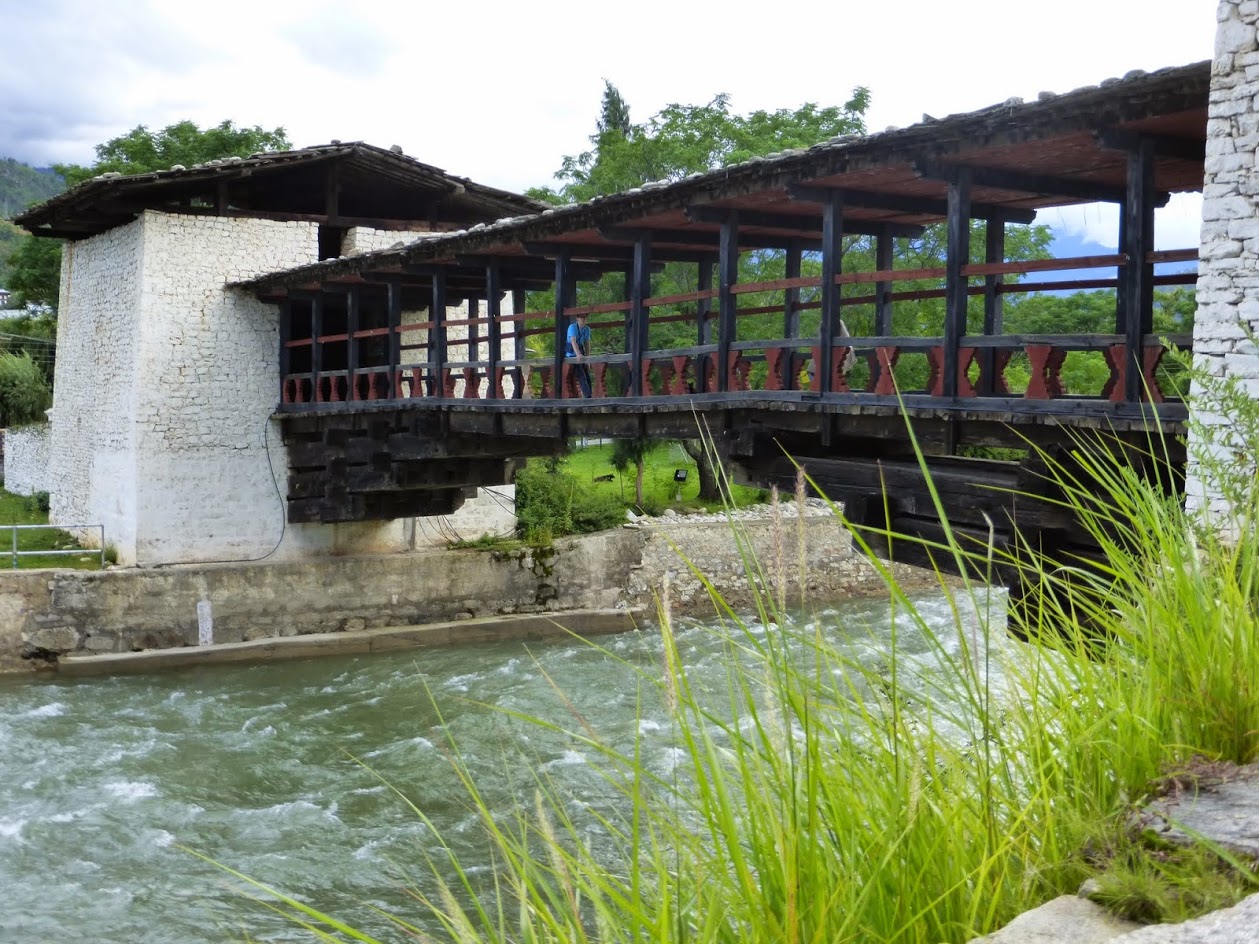
The Centenary Farmers' Market is busiest from Friday to Sunday, when growers bring chillies, red rice, cheese, dried yak cheese and mushrooms. Cross the cantilever footbridge to the craft stalls on the far bank, where prayer flags and wooden masks are cheaper than in hotel shops.

An archery match at Changlimithang

Archery is the national sport, and on weekends and holidays teams compete at the Changlimithang ground with targets about 145 m apart. Teams dance and sing to tease the opposing side. Watching is free; ask your guide which ground has a match.

Told in the hills

The takin that a saint made from leftovers

Bhutan's national animal looks as if it was assembled from spare parts: the head of a goat on the body of a cow. Bhutanese legend says that is exactly what happened. The 15th-century saint Drukpa Kunley, the 'Divine Madman', was asked by villagers to show a miracle. He demanded a whole cow and a whole goat for lunch, ate both, then stuck the goat's head on the cow's bones and told the creature to get up. It rose and walked off to graze, and people called it the takin. The takin was declared the national animal in 2005.

The Motithang Takin Preserve has its own true story. Thimphu once kept takins in a small zoo. Wikipedia records that the king felt it was improper for a Buddhist country to keep animals confined, so they were released. The takins did not head for the hills; they wandered the streets of Thimphu for weeks looking for food. The answer was a fenced patch of forest on the edge of the city at Motithang, where they live today and where you can watch them from a raised walkway.

Pinned to the board

Did you know

Thimphu has no traffic lights; police officers direct traffic by hand at the main junctions.

The Buddha Dordenma statue above Thimphu, finished in 2015, holds 125,000 smaller gilded Buddha statues inside it.

Simtokha Dzong, built by the Zhabdrung in 1629 just south of Thimphu, is considered the oldest surviving dzong in Bhutan.

Getting there

How to reach Thimphu

Reserved car with guideFrom Phuentsholing it is about 165 km and 5–6 hours via Rinchending, Gedu, Chukha and Chhuzom. Under the April 2026 Department of Tourism notification, tourists travel with a licensed guide beyond the first checkpoint, so most people use a Bhutan-registered car with driver: ₹4,500–6,500 a day, indicative 2026.
BusBhutanese buses run Phuentsholing to Thimphu for about Nu 250–350 a seat. They are cheap and safe, but as a tourist you still need your guide with you, which cancels most of the saving. They suit Bhutanese residents better than visitors. Check current status before you travel.
AirParo is the country's international airport, about 50 km and just over an hour from Thimphu. Drukair and Bhutan Airlines fly to Paro from Delhi and Kolkata, and Drukair runs a few weekly flights from Bagdogra; schedules change by season, so check before you book.

Costs in Thimphuindicative, 2026

  • Buddha Dordenma entry≈ Nu 300 per person, indicative 2026
  • Tashichho Dzong, Memorial Chorten, Simtokha≈ Nu 500 each, indicative 2026
  • Licensed guide₹2,000–3,000 a day, indicative 2026
  • Car with driver₹4,500–6,500 a day, indicative 2026
  • Certified 3-star hotel₹3,500–5,500 per room night, indicative 2026
  • Local lunch₹250–500 per person, indicative 2026

Fares and fees change with fuel prices, season and local union rates. Check current rates before you travel.

Money-saving tip

Watch archery, walk the Memorial Chorten loop and browse the weekend market, which cost nothing, and choose two paid monuments rather than five to save ₹1,000–1,500 per person.

Where to stay

Sleeping in Thimphu

Stay in the city centre around Norzin Lam, the Clock Tower Square and Chubachu so you can walk to cafes, the craft bazaar and the market. Hotel Druk on the Clock Tower Square is a solid comfortable choice with heating that works. Certified 3-star hotels on Norzin Lam and in Changzamtog are the budget option at ₹3,500–5,500 per room night. For premium, Taj Tashi sits a few minutes' walk from Tashichho Dzong, and Le Méridien Thimphu is close by. Motithang and Babesa are quieter but you will need the car for every outing.

Tour packages

Packages that stop in Thimphu

Bhutan by road from Siliguri in 6 nights
Nº 31432 · Bhutan6N / 7D Bhutan by road from Siliguri in 6 nights Phuentsholing → Thimphu → Paro → Phuentsholing Budget fare from
per person, twin
₹31,000
Bhutan family trip in 6 nights
Nº 89650 · Bhutan6N / 7D Bhutan family trip in 6 nights Thimphu → Punakha → Paro Budget fare from
per person, twin
₹33,500
Bhutan honeymoon in 7 nights
Nº 66771 · Bhutan7N / 8D Bhutan honeymoon in 7 nights Thimphu → Punakha → Paro Budget fare from
per person, twin
₹37,000
Bumthang and central Bhutan in 9 nights
Nº 63730 · Bhutan9N / 10D Bumthang and central Bhutan in 9 nights Thimphu → Punakha → Phobjikha and Gangtey → Trongsa → Bumthang → Wangdue Phodrang → Paro Budget fare from
per person, twin
₹47,000
Darjeeling and Bhutan by road in 8 nights
Nº 71914 · Bhutan8N / 9D Darjeeling and Bhutan by road in 8 nights Darjeeling → Phuentsholing → Thimphu → Paro → Phuentsholing Budget fare from
per person, twin
₹39,000
Paro Tshechu festival trip in 6 nights
Nº 79601 · Bhutan6N / 7D Paro Tshechu festival trip in 6 nights Thimphu → Punakha → Paro Budget fare from
per person, twin
₹36,500
Phobjikha and the black-necked cranes in 7 nights
Nº 12843 · Bhutan7N / 8D Phobjikha and the black-necked cranes in 7 nights Thimphu → Punakha → Phobjikha and Gangtey → Paro Budget fare from
per person, twin
₹37,500
Thimphu and Paro classic in 4 nights
Nº 11927 · Bhutan4N / 5D Thimphu and Paro classic in 4 nights Thimphu → Paro Budget fare from
per person, twin
₹26,000

On the map

Map of Thimphu, Paro, Dochula Pass, Punakha, Druk Path TrekIndiaChinaBhutanThimphu1ThimphuParo2ParoDochula Pass3Dochula PassPunakha4PunakhaDruk Path Trek5Druk Path Trek20 kmN
  1. 1Thimphu
  2. 2Paro
  3. 3Dochula Pass
  4. 4Punakha
  5. 5Druk Path Trek
Drawn by Darjeeling Tour Plan from Natural Earth outlines (public domain). Borders as depicted by India. Not for navigation.

Questions people ask

Thimphu: questions answered

How many days are enough for Thimphu

Two nights cover the main sights: Buddha Dordenma, Tashichho Dzong, Memorial Chorten, the takin preserve, Simtokha Dzong, the Folk Heritage Museum and the weekend market. Add a third night for a half-day hike to Tango or Cheri monastery, or to sort a route permit if you arrive at the end of the week.

Do Indians need a guide in Thimphu

Yes, as we read the current rules. A Department of Tourism notification of 8 April 2026 says all tourists must be accompanied by a licensed guide beyond the first checkpoint, including in transit and at monuments. Older advice that Indians can explore Thimphu alone is out of date. Check current status before you travel.

Where do I get the route permit for Punakha in Thimphu

At the Department of Immigration office in Thimphu, on working days, Monday to Friday. Your tour operator or guide normally applies for you with your entry permit and itinerary. It is needed for Punakha, Wangdue, Phobjikha, Haa, Bumthang and other districts beyond Thimphu and Paro. Check current status before you travel.

Is Thimphu cold in winter

Yes. From December to February nights go below 0 °C and days reach about 10–14 °C. Skies are often clear and the light is beautiful, but hotel heating matters. Pack a down jacket, warm socks and gloves. Snowfall in the city is occasional and light; Dochula pass on the Punakha road gets more.

What is the best time to visit Thimphu

March to May and September to November. Spring brings blossom and mild days; autumn brings clear skies and the Thimphu Tshechu festival in September or October. Winter is cold but clear and cheaper. June to August is the monsoon, green but wet, with landslide risk on the road from Phuentsholing.

How far is Paro from Thimphu

About 55 km, roughly 1 to 1.5 hours by car. The road follows the Wang Chhu down to Chhuzom, where the Paro and Thimphu rivers meet, then climbs up the Paro valley. Most itineraries visit Thimphu first and end in Paro, because the airport is there and Tiger's Nest is best done near the end of the trip.

Is there a dress code in Thimphu

On the streets, no. Inside dzongs, temples and the Memorial Chorten you need long sleeves and long trousers or a long skirt, and no caps. Bhutanese wear the gho and kira at work and at religious sites, and visitors who wear them for a festival are welcomed. Smart, modest clothes work everywhere.

What can I buy in Thimphu

Handwoven textiles, prayer flags, incense, wooden masks, bamboo baskets, Bhutanese red rice, dried chillies and local cheese. The craft bazaar and the weekend market stalls are cheaper than hotel shops. Textiles from the Royal Textile Academy shop are pricier but well made. Ask before buying antiques; export of old religious items is restricted.

Is Thimphu expensive for Indian tourists

Moderately. The SDF is ₹1,200 per person per night, a certified 3-star hotel costs ₹3,500–5,500 per room, and a guide plus car run ₹6,500–9,500 a day split across your group. Food in local restaurants is ₹250–500 a meal. A group of four sharing car and guide pays far less per head than a couple; indicative 2026.

Start planning

Tell us the trip, we'll price it three ways

Dates, who is coming and roughly what you want to spend. A planner replies within one working day with a route and a budget, comfort and premium price, so you can see exactly what each extra rupee buys.

  • No payment to startPay only when you confirm
  • Three prices, in writingBudget, comfort, premium, line by line
  • One plannerOn WhatsApp from pickup to drop
  • Permits handledSikkim and Bhutan paperwork sorted

Get a free plan and price

Reply within one working day · no payment to start

We reply by email or WhatsApp. Read our privacy policy.

Get a free plan