Told in the hills
How a forest ridge became the Darjeeling hills
Before the British, these hills were Lepcha country, part of the kingdom of Sikkim. In the late eighteenth century the Gorkha armies of Nepal overran much of the area. After the Anglo-Nepalese War, the Treaty of Sugauli of 1816 and the Treaty of Titalia of 1817 handed the tract back to Sikkim, with the British as arbiters. In 1829 two officers, George Lloyd and J.W. Grant, visited the ridge and recommended it as a sanatorium for soldiers and officials from the hot plains.
On 1 February 1835 the Chogyal of Sikkim signed a Deed of Grant giving the Darjeeling hill to the East India Company. Relations soured, and in 1849 the Sikkim court detained Archibald Campbell, the superintendent, and the botanist Joseph Hooker. In response, the British annexed the hills and the Terai below in 1850. In 1865, after the Bhutan War, the Treaty of Sinchula added Kalimpong east of the Teesta, which remained part of Darjeeling district until it became a separate district in 2017.
Tea and the railway made the district. Gardens spread from the 1850s, worked largely by labourers who came from Nepal, and the Darjeeling Himalayan Railway reached the town in 1881. The Nepali-speaking majority that grew from this history has long sought a separate identity within India, and in 2012 the Gorkhaland Territorial Administration was set up to run many local affairs. When you ride the toy train or walk through a tea estate, you are moving through that history.
Pinned to the board
Did you know
The Darjeeling Himalayan Railway was inscribed as a UNESCO World Heritage Site in 1999.
Darjeeling tea was the first product in India to receive a Geographical Indication tag, registered in 2004–05.
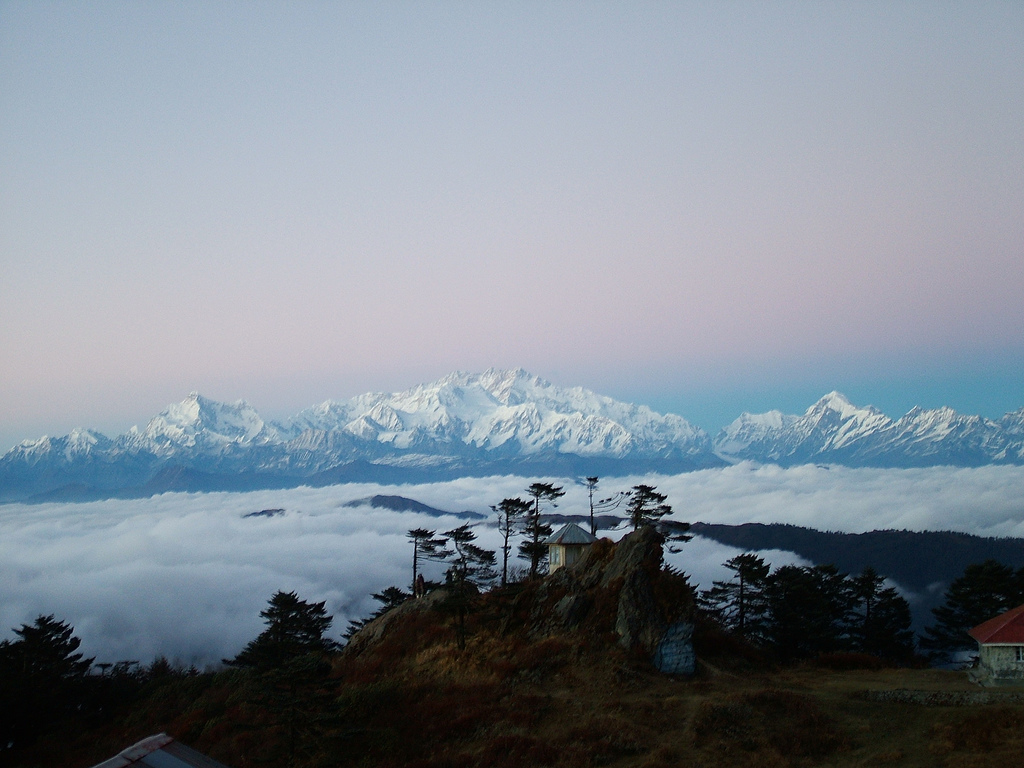
Sandakphu, at 3,636 m on the Singalila Ridge, is the highest point in West Bengal and shows four of the world's five highest peaks on a clear day.
Kalimpong was part of Darjeeling district from 1866 until it was made a separate district in 2017.
Rabindranath Tagore stayed at Maitreyi Devi's house in Mungpoo on four visits between 1938 and 1940; it is now the Rabindra Bhavan museum.