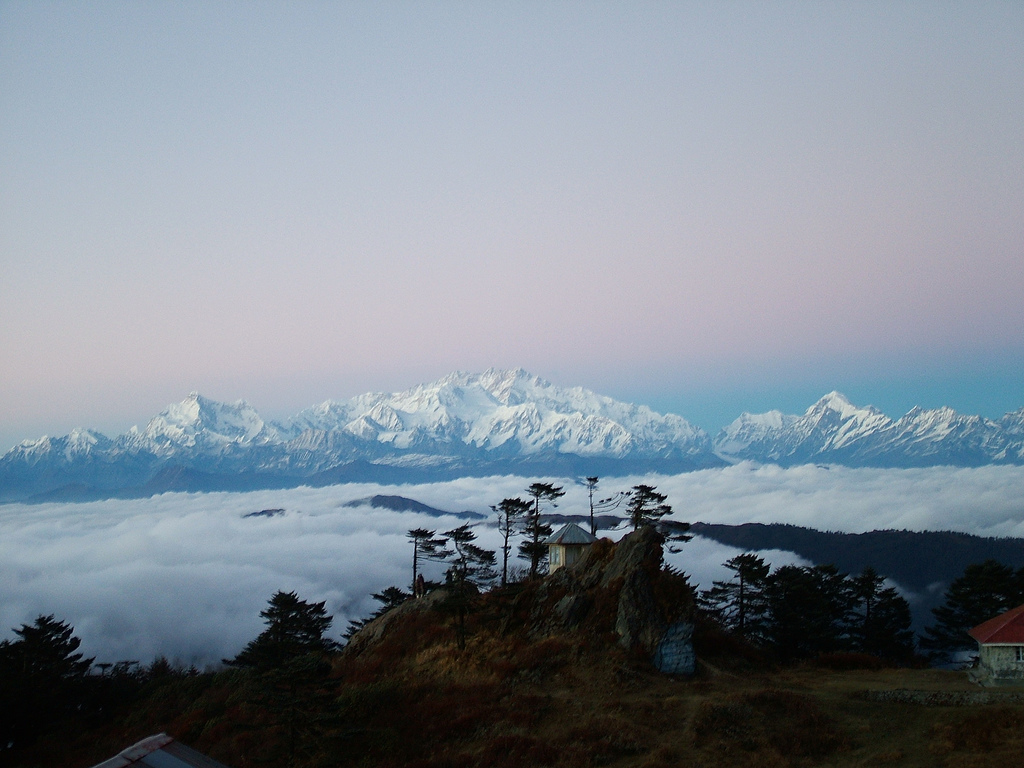
Why Sandakphu, and what it is like
Sandakphu, at 3,636 m, is the highest point in West Bengal and sits on the Singalila ridge, which forms the border between India and Nepal west of Darjeeling. From its top, on a clear morning, you see four of the five highest mountains in the world: Kangchenjunga to the north, and Everest, Lhotse and Makalu to the west. The ridge runs on north to Phalut, at about 3,600 m, close to where Nepal, West Bengal and Sikkim meet.
Most of the route lies inside Singalila National Park, known for red pandas, Himalayan black bears and rhododendron and oak forests. The trek is moderate. There are no ropes, glaciers or technical climbs, and you sleep in lodges, not tents. But the days are long, the climb to Sandakphu is steep, and nights above 3,000 m are cold. Anyone who walks regularly and prepares for a few weeks can do it.
Choosing your route
All routes start at Manebhanjan, at 2,134 m, about 26 km and 1–1.5 hours from Darjeeling. They differ in how far north you go and how you come down. Distances are approximate trail kilometres; daily times are for an average walker with rests.
| Route | Days walking | Approx. distance | Suits |
|---|---|---|---|
| Manebhanjan – Sandakphu – Gurdum – Srikhola | 4 | ≈ 50 km | First-timers, short holidays |
| Manebhanjan – Sandakphu – Phalut – Gorkhey – Rammam – Srikhola | 6 | ≈ 75–80 km | The full ridge, best views |
| Land Rover to Sandakphu, walk back to Manebhanjan | 2 | ≈ 31 km | Limited time, one-way walkers |
| Land Rover up and down with a night at Tumling | 0–1 | Short walks only | Families, seniors |
The classic stages
The usual stages on the full route, with approximate altitudes, are below. Lodges sit at each stop, so you can shorten or split days if needed.
- Day 1: Manebhanjan (2,134 m) to Tumling (≈ 2,970 m), about 11 km. Steep start to Chitrey, then gentler.
- Day 2: Tumling to Kalipokhri (≈ 3,186 m) via Gairibas, about 13 km through forest. First night above 3,000 m.
- Day 3: Kalipokhri to Sandakphu (3,636 m) via Bikheybhanjang, about 6 km; the last 4 km are steep.
- Day 4: Sandakphu to Phalut (≈ 3,600 m) via Sabargram, about 21 km along the open ridge, with little water or shade.
- Day 5: Phalut down to Gorkhey (≈ 2,400 m), about 15 km of steep descent through forest.
- Day 6: Gorkhey to Rammam (≈ 2,560 m) via Samanden, about 9 km, then on to Srikhola (≈ 1,900 m) the next morning, or in one long day.
- Short route: from Sandakphu descend to Gurdum and Srikhola, about 14–16 km, in one long day.
Guides, permits and park rules
Singalila National Park rules require trekkers to hire a licensed guide, booked through the park office or the guides' association at Manebhanjan; you cannot trek the park alone. Guides cost about ₹1,000–1,500 a day per group, indicative 2026, and porters ₹800–1,200 a day each. Park entry is charged per day, roughly ₹100–200 for Indians and more for foreigners, with extra fees for cameras and vehicles. Carry original photo ID; foreign nationals must carry their passport and Indian visa, as the trail crosses the open Nepal border several times.
The park closes to trekkers from about 16 June to 15 September for the monsoon. Rules on guides, lodges, fees and group sizes have changed several times in recent years, and new rules can arrive at short notice. Check current status before you travel, and ask your guide to confirm the latest position when you book.
What it costs
Costs depend mostly on group size, since guides and vehicles are charged per group. A group of four sharing one guide, staying in basic lodges and eating at the lodges, spends roughly ₹2,000–3,000 per person a day, indicative 2026. That covers a bed in a shared room or dorm at ₹500–1,500, meals at ₹600–1,000 a day, a share of the guide, and park fees. A solo trekker paying a guide alone may spend ₹3,500–4,500 a day.
Add transport at both ends: shared jeeps from Darjeeling to Manebhanjan cost ₹80–150 a seat, and from Srikhola or Rimbik back to Darjeeling a little more. A Land Rover from Manebhanjan to Sandakphu and back costs ₹5,500–7,500 per vehicle, more with overnight halts. Packaged treks from Darjeeling with everything arranged cost from about ₹17,000–20,000 per person for the full Phalut route. Carry enough cash: there are no ATMs on the trail.
Getting to Manebhanjan and home again
Most trekkers base themselves in Darjeeling the night before. Shared jeeps for Manebhanjan leave the Darjeeling motor stands near Chowk Bazaar from early morning and take 1–1.5 hours via Ghum and Sukhiapokhri; a seat costs ₹80–150, indicative 2026, and a reserved car ₹1,500–2,500. Aim to reach Manebhanjan by 8–9 am so you can sort the guide and park entry and still walk to Tumling before the afternoon cloud. Some trekkers sleep in Manebhanjan itself, where there are simple lodges near the park office.
The return is harder to arrange. Srikhola and Rimbik, where the longer routes end, have a few shared jeeps to Darjeeling, mostly in the morning and early afternoon, and seats are limited. Ask your guide to book a seat or a vehicle a day ahead from the trail. A reserved car from Srikhola to Darjeeling costs roughly ₹3,500–5,000 and to Siliguri more. Do not book a train or flight for the evening of your last walking day; a night in Darjeeling first is safer and far more comfortable.
When to go
October and November are the best months for clear views; the air is washed clean by the monsoon, days are dry and nights are cold but manageable. April and May bring the rhododendrons into flower, turning whole hillsides red, pink and white, but haze and afternoon cloud often hide Everest after mid-morning. March and early December are quieter, with good views and colder nights.
From late December to February, snow can cover the ridge and night temperatures fall to −10 °C or lower; the trek is possible for well-equipped trekkers with an experienced guide, but the Phalut stretch can become hard going. Avoid weekends and Puja holidays in October if you want space in the lodges at Sandakphu, which fill quickly.
Altitude, fitness and packing
The route climbs gradually, and serious altitude sickness is uncommon, but headaches and breathlessness above 3,000 m are normal. Sleep a night in Darjeeling before you start, walk slowly, drink 3–4 litres of water a day and avoid alcohol. If anyone vomits, becomes confused or cannot walk straight, descend at once. Start walking or stair training four to six weeks ahead; the descent from Phalut is hard on unprepared knees.
Pack light, since you carry your own bag unless you hire a porter. These are the things we insist on:
- Broken-in trekking shoes with good grip, and two pairs of woollen socks.
- A down jacket or heavy fleece, thermals, a woollen cap and gloves, in every season.
- A rain jacket and pack cover; weather on the ridge changes fast.
- A headtorch, power bank, sunscreen, sunglasses and lip balm.
- Water bottles for 2 litres, purification tablets and oral rehydration salts.
- A small first-aid kit, personal medicines and blister plasters.
- Cash for lodges, porters and tips, and photo ID or passport.
Questions people ask
Good to know
How many days are needed for the Sandakphu trek
Four days of walking for the short route up to Sandakphu and down via Gurdum to Srikhola, or six days for the full loop via Phalut, Gorkhey and Rammam. Add a night in Darjeeling before you start and a travel day at each end. With a Land Rover, you can reach Sandakphu in one or two days.
Is the Sandakphu trek good for beginners
Yes, for fit beginners. There are no technical sections, you sleep in lodges, and a guide handles the logistics. The challenges are long days, a steep climb to Sandakphu and cold nights above 3,000 m. If you can walk 8–10 km on hilly ground without trouble, you can do the short route. Train for a few weeks first.
Do I need a permit for Sandakphu
You need to pay Singalila National Park entry at Manebhanjan and hire a licensed guide; there is no separate trekking permit for Indians. Foreign nationals pay a higher fee and must carry their passport and visa because the trail crosses the Nepal border. Rules change, so check current status before you travel.
How cold is Sandakphu
Cold at night in every season. In October and November nights fall to about 0 to −5 °C; in April and May to around 0–5 °C; from December to February to −10 °C or lower, with snow. Days can be pleasant in sunshine but windy on the ridge. Pack a down jacket, thermals, cap and gloves whatever the month.
Can I do the Sandakphu trek without a guide
No. Singalila National Park rules require trekkers to hire a licensed guide at Manebhanjan, and park staff check. Guides cost about ₹1,000–1,500 a day per group, indicative 2026, so they are affordable when shared. Beyond the rules, a guide helps on a trail that forks into Nepal and where weather can turn fast.
What are the lodges like on the Sandakphu trek
Simple. Trekkers' huts and private lodges offer dorm beds or basic twin rooms with thick quilts, shared toilets and limited hot water, often for a fee. Meals are rice, dal, vegetables, noodles and eggs. Electricity comes from the grid, solar or generators for limited hours. Book through your guide in peak weeks.
When do rhododendrons bloom on the Singalila ridge
From about late March to May, depending on altitude and the year. Lower forests near Tumling and Gairibas flower first, and the ridge near Sandakphu and Phalut follows into May. The flowering is a reason many trekkers choose spring, though haze can hide the far mountains by mid-morning.
How much does the Sandakphu trek cost
In a group of four, about ₹2,000–3,000 per person a day for lodges, meals, a shared guide and park fees, indicative 2026, plus transport to Manebhanjan and back. A full 6-day trek therefore costs roughly ₹12,000–18,000 each before travel to Darjeeling. Packaged treks with everything arranged start around ₹17,000–20,000.
Is there mobile network on the Sandakphu trek
Patchy. In some places an Indian network works, in others only a Nepali one, and in forest stretches there is none. Sandakphu has intermittent signal. Download offline maps, tell family you may be out of touch for a day or two, and carry a power bank, as charging at lodges is limited and may cost extra.