
Key takeaways
- October, November and December give the best odds: clear mornings on most days, with the sharpest light in November.
- January to February stays good but cold; March and April are hazy, with clear views mostly at dawn.
- From June to mid-September the monsoon hides the mountain most days; a clear dawn is a bonus, not a plan.
- Mornings beat afternoons in every month; be at your viewpoint by sunrise and give yourself at least two mornings.
Why the season matters so much
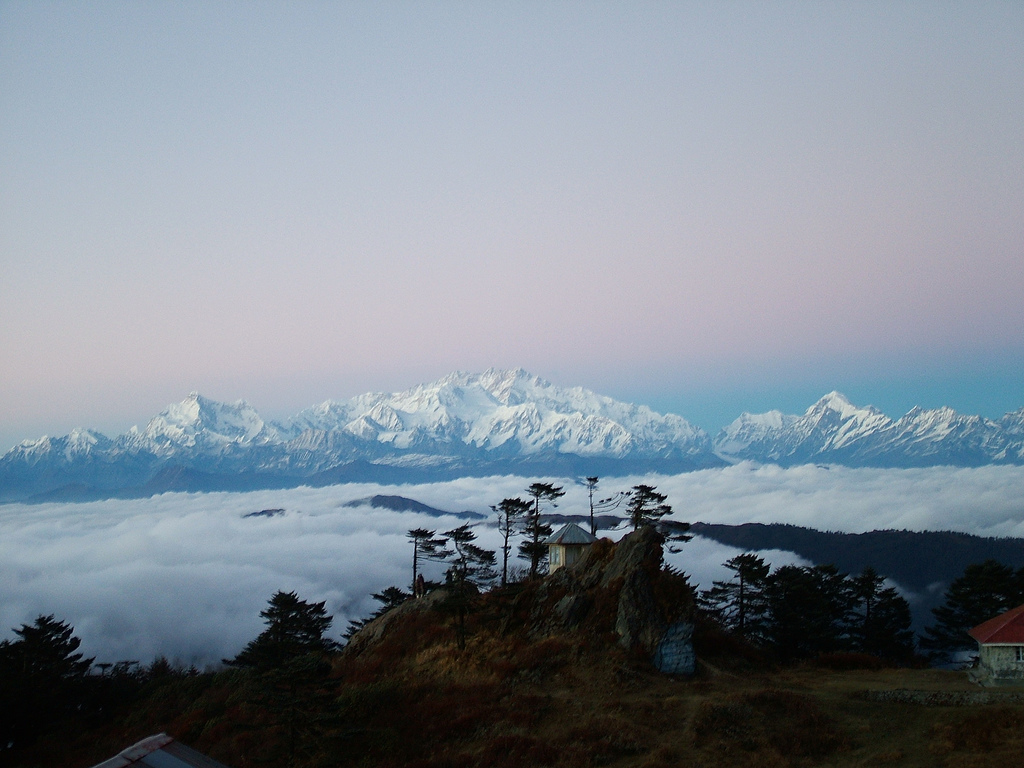
Kangchenjunga, at 8,586 m, is the third-highest mountain in the world, and from Darjeeling, Pelling or Gangtok it sits on the northern horizon like a wall. Until surveyors in the mid-nineteenth century worked out that Everest was higher, it was thought to be the highest mountain on earth. On a clear morning it fills a third of the sky from Darjeeling's Chowrasta. On a cloudy one there is nothing to show it was ever there.
Whether you see it depends almost entirely on the month and the hour. The eastern Himalaya gets a strong south-west monsoon from June to September, and moisture lingers in the valleys for weeks either side. After the rains clear in early October, the air is washed clean and stays dry until the spring haze from farm burning and dust builds in March. That window, October to February, is when we plan trips for people whose main reason to come is the mountain.

The month-by-month table
These are our planning odds for a clear sight of the summit at some point in the morning, based on years of running trips and on the usual weather pattern. They are rough guides, not a forecast, and any given week can surprise you either way.
| Month | Chance of a clear morning | What to expect |
|---|---|---|
| January | Good | Clear, cold dawns; Darjeeling 2–9 °C; occasional snow cloud |
| February | Good | Mostly clear; slightly warmer; some western disturbances |
| March | Fair | Haze builds; clear at dawn, gone by 9 am |
| April | Fair to poor | Haze and pre-monsoon cloud; rhododendrons make up for it |
| May | Poor | Afternoon storms; clear spells are short |
| June | Very poor | Monsoon arrives; mountain rarely seen |
| July | Very poor | Peak rain; a lucky dawn now and then |
| August | Very poor | Peak rain continues |
| September | Poor to fair | Breaks in the rain late in the month; crisp if you get one |
| October | Very good | Rains clear; sharp views after the first week |
| November | Excellent | The best month; clear most mornings and many afternoons |
| December | Very good | Clear and cold; short days |
October to December: the main window
If you can pick only one month, pick November. The monsoon moisture is gone, the cold has not yet set in hard, and the air is dry enough that the mountain often stays visible well past breakfast. In Darjeeling the town is around 7–15 °C, comfortable with a jacket. This is also when you have the best chance of seeing Everest from Tiger Hill, a small dark peak far to the west, about 170 km away.
October is nearly as good after the first week, when the last monsoon showers have passed. The catch is crowds: Durga Puja and Diwali fill every hotel and road in the hills, and Tiger Hill can have hundreds of cars at dawn. December is clear and quieter, but the days are short and mornings are near freezing in Darjeeling and Pelling.


We will build your dates so you get at least two mornings facing the mountain.
January to April: cold, then hazy
January and February are underrated. Skies are often as clear as in December, rates are lower, and the roads are empty. The price is the cold: 2–9 °C in Darjeeling and colder in Pelling at dawn, with patchy heating in budget hotels. A western disturbance can bring two or three grey days and even snow on Tiger Hill, so build in a spare morning.
From March the picture changes. Dust and smoke from the plains drift up into the hills, and by mid-morning the mountain softens into a pale outline. Dawn is still often clear. April brings rhododendrons, magnolias and first-flush tea, which are good reasons to come, but come for those, not for the mountain.
May to September: monsoon odds
We are honest with travellers about the monsoon. From June to mid-September, you can spend five nights in Darjeeling and never see Kangchenjunga. Some years there is a clear dawn after a night of heavy rain, and those views are spectacular in their own way, washed and close. But you cannot plan around them.
The monsoon has other things going for it: green tea gardens, waterfalls, hotel discounts of 30–50 percent and empty viewpoints. If the mountain is your main reason, wait until October. If it is a bonus, the rains are fine. Landslides can close roads and suspend the toy train, so check current status before you travel.
Late September is a gamble worth knowing about. In some years the rains ease in the last ten days, and you get October views at monsoon prices.
Where to watch from
The best viewpoint depends on where you are staying, and none of them needs a big spend.
Pelling and Gangtok see the mountain from different angles: Pelling faces it head-on across the Rangeet valley, and is the closest of the three towns; Gangtok sees it further off, past a line of ridges, from Ganesh Tok and the Tashi viewpoint. Sandakphu, at 3,636 m on the Singalila ridge, is the one place in this region where you see Kangchenjunga and Everest together, along with Lhotse and Makalu, but it is a trek or a long Land Rover ride, best in October, November and April.
- Darjeeling Chowrasta and the Mall: free, five minutes from most hotels, good from first light
- Tiger Hill, 2,567 m: the classic sunrise, 11 km from town, reserved car about ₹1,500–2,500, indicative 2026
- Pelling: many hotel rooftops face the mountain directly; Sanga Choeling and Pemayangtse ridges too
- Gangtok: Ganesh Tok and Tashi viewpoint early in the morning
- Sandakphu: the full panorama including Everest, for those who can trek or ride up


Matching the mountain to your trip
Most travellers do not plan a whole trip around one view, and they do not need to. Here is how we fit the mountain into the kinds of trips people actually take.
For a first trip in October or November, two nights in Darjeeling and two in Pelling give you four mornings facing Kangchenjunga from two angles, and the odds that at least two are clear are high. Gangtok adds Tsomgo and good food but a more distant view, so we count it as a bonus rather than a viewing base.
For a winter trip in January, stay longer in fewer places. Three nights in Darjeeling, with Tiger Hill kept for whichever morning dawns clear, beats a rushed circuit. Pack thermals and ask your hotel about heaters before you book; in budget rooms they are often an extra ₹200–500 a night, indicative 2026.
For a spring trip in March or April, come for rhododendrons, birds and first-flush tea, and treat the mountain as a dawn-only event. Set an alarm for 5 am, look once, and go back to bed if the horizon is milky. For Sandakphu, go in the second half of October or in early April, when the trail is drier and the air is often clearest above the haze line.
In the monsoon, choose the trip for its own sake: tea gardens at their greenest, waterfalls on the Hill Cart Road, empty monasteries and hotel discounts. If you happen to wake to a clear sky, you will have the view almost to yourself.
Small habits that improve your odds
Plan two or three mornings in a town with a view, not one. The single biggest reason people miss the mountain is a schedule that puts them in Darjeeling for one night only. Check the sky at 4 am before driving to Tiger Hill; if stars are out, go, and if not, sleep in and try the Mall at 6 am. Ask for a north-facing room in Darjeeling or Pelling, which often costs ₹500–1,000 more a night but gives you the mountain from bed.
Finally, a note on respect. Kangchenjunga is a sacred mountain to the people of Sikkim. Pang Lhabsol, held in late summer, honours it as a guardian deity, and climbers on the first ascent in 1955 stopped short of the true summit out of respect for that belief, a tradition many later expeditions have kept.


Journeys from this article
Start from a route

per person, twin₹13,000
per person, twin₹20,000 Build your own route Tell us your dates, who is coming and what you want to see. We draw the route and price it three ways. Start Working to a budget? Give us a number per person. We will tell you honestly what it buys, and where to save. Start Ask someone who has been A first plan and price within one working day. No payment to start. Start
Questions people ask
Good to know
Which month is best to see Kangchenjunga from Darjeeling
November is the best single month, with clear mornings on most days and dry air that often keeps the mountain visible past breakfast. October after the first week and December are nearly as good. January and February are also clear but cold, and from March onwards haze makes views shorter and less reliable.
Can you see Kangchenjunga in the monsoon
Sometimes, but rarely. From June to mid-September cloud hides the mountain on most days, and you can spend several nights in Darjeeling without a single view. A clear dawn after heavy rain does happen and can be very sharp. If the mountain is your main reason to travel, choose October to February instead.
What time of day is best to see Kangchenjunga
Early morning, from first light to about 9 am, in every month. Cloud and haze build as the valleys warm up during the day. In November and December the mountain often stays clear through the afternoon too, but in spring it can vanish within an hour of sunrise. Be outside before dawn for the best chance.
Can you see Kangchenjunga from Gangtok
Yes, on clear mornings, mainly from Ganesh Tok, the Tashi viewpoint and many hotel rooftops. Gangtok sees it from further away than Darjeeling or Pelling, past several ridges, so it looks smaller. The best odds are from October to February. Pelling gives the closest and most direct view of the three towns.
Is Tiger Hill worth it if the sky is cloudy
No. If the sky is cloudy at 4 am, the drive and the ₹1,500–2,500 car fare, indicative 2026, usually buy you a grey view and a cold wait. Look out of the window before you leave. If you see stars, go. If not, sleep in and try the Mall or Chowrasta later, or move Tiger Hill to your next morning.


